GeoDexGrasp: Geometry-aware Generation for Data-efficient and Physics-plausible Dexterous Grasping

CVPR 2026
Bing Han1,2, Weiyuan Liu1, Changlong Zhang1, Chenxi Wang1, Zhibin Zhao1, Zhi Zhai1
1Xi'an Jiaotong University     2Galbot
Accepted by the IEEE/CVF Conference on Computer Vision and Pattern Recognition (CVPR) 2026
Teaser image

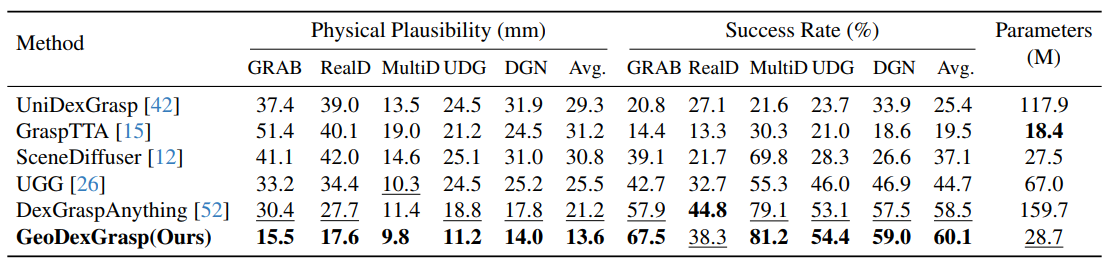
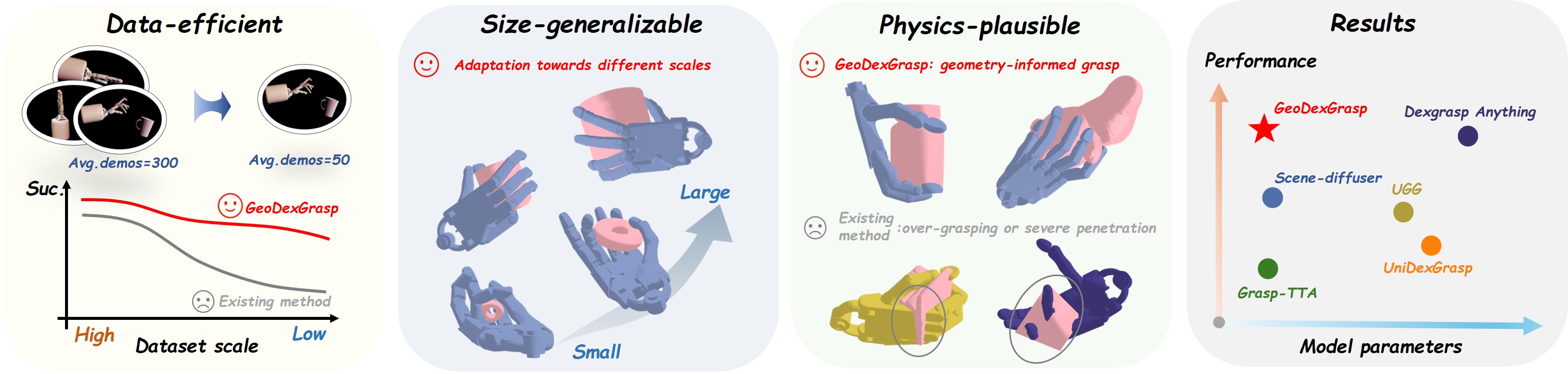
TL;DR: We propose a data-efficient, size-generalizable, and physics-plausible method for dexterous grasp generation, achieving state-of-the-art physical plausibility and competitive grasping performance with substantially fewer parameters than previous state-of-the-art methods.

Abstract

Achieving dexterous grasping remains a key challenge in robotics. Recent generative approaches enable diverse grasps through large-scale data-driven training, yet they often neglect geometric priors of objects, which leads to low data efficiency and poor physical plausibility. We propose GeoDexGrasp, a geometry-aware generation framework for dexterous grasping built upon object-centric geometric representations. We introduce a SIM(3)-equivariant network equipped with a self-supervised disentanglement strategy to extract interpretable and transferable geometric features, including shape, size, pose, and interaction direction. The overall generation process is then decomposed into two stages: first, root rotation generation conditioned on pose and interaction direction; second, hand grasp generation guided by shape and size. By leveraging geometric representations, GeoDexGrasp achieves state-of-the-art physical plausibility (reducing 40% penetration depth) across five datasets and exhibits improved data efficiency. Additionally, GeoDexGrasp is lightweight, using less than 20% of the parameters of the previous state-of-the-art method, while attaining a comparable grasp success rate.
Method

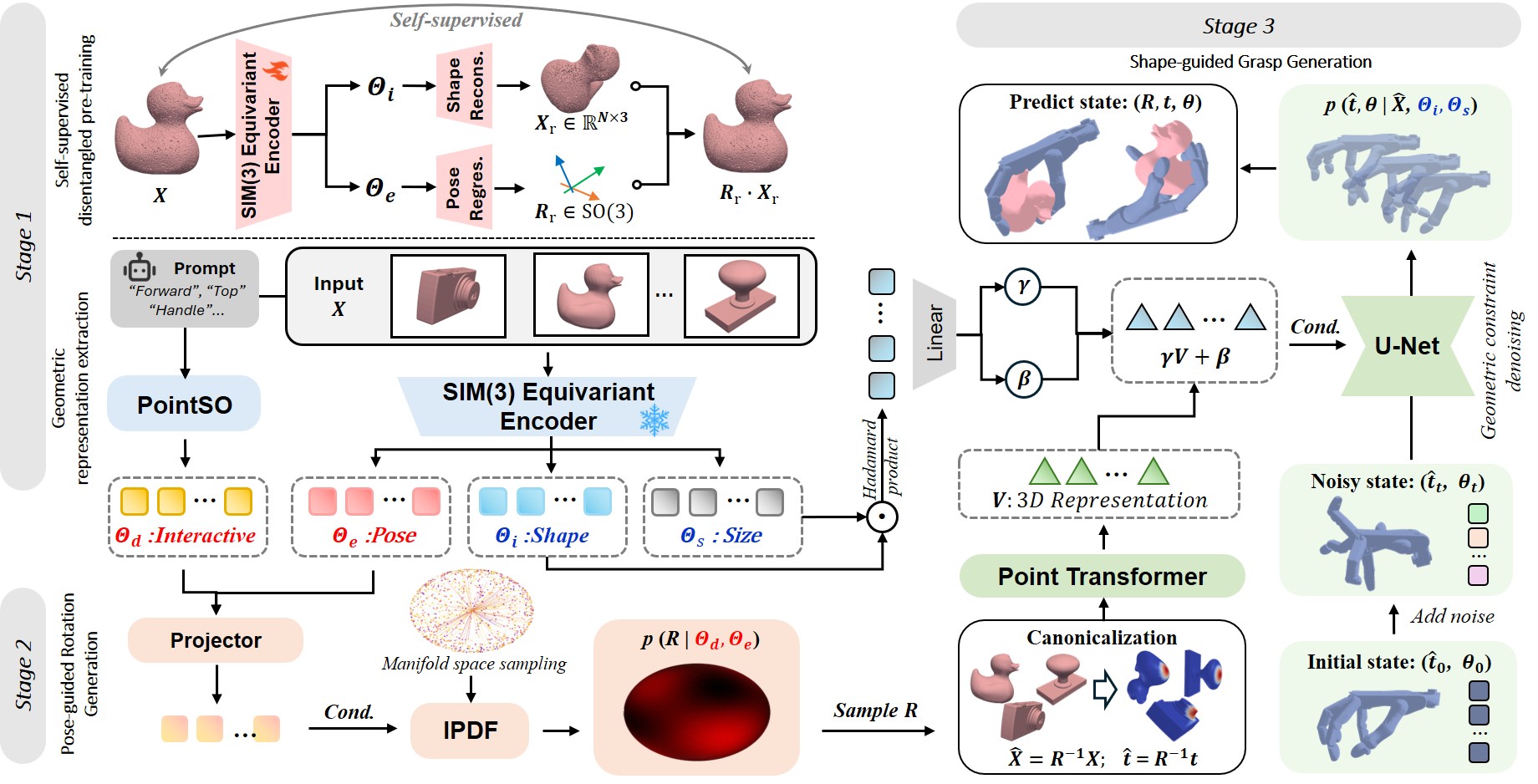
Method architecture

Overall architecture. Pipeline of GeoDexGrasp. When the object undergoes pose, shape, or size variation, we expect the model to adapt its predictions accordingly rather than treating them as entirely new cases. GeoDexGrasp consists of three stages. Stage 1: Geometric representation learning and extraction. A SIM(3)-equivariant network is employed for self-supervised disentangled pretraining to obtain transferable geometric representations aligned with high-level semantics. Stage 2: Pose-guided rotation generation. Rotational distributions in SO(3) space are generated conditioned on pose representations and interaction directions. Stage 3: Shape-guided grasp generation. A diffusion model conditioned on object shape and size representations generates the final grasp in Euclidean space.

Results

Experimental results 1

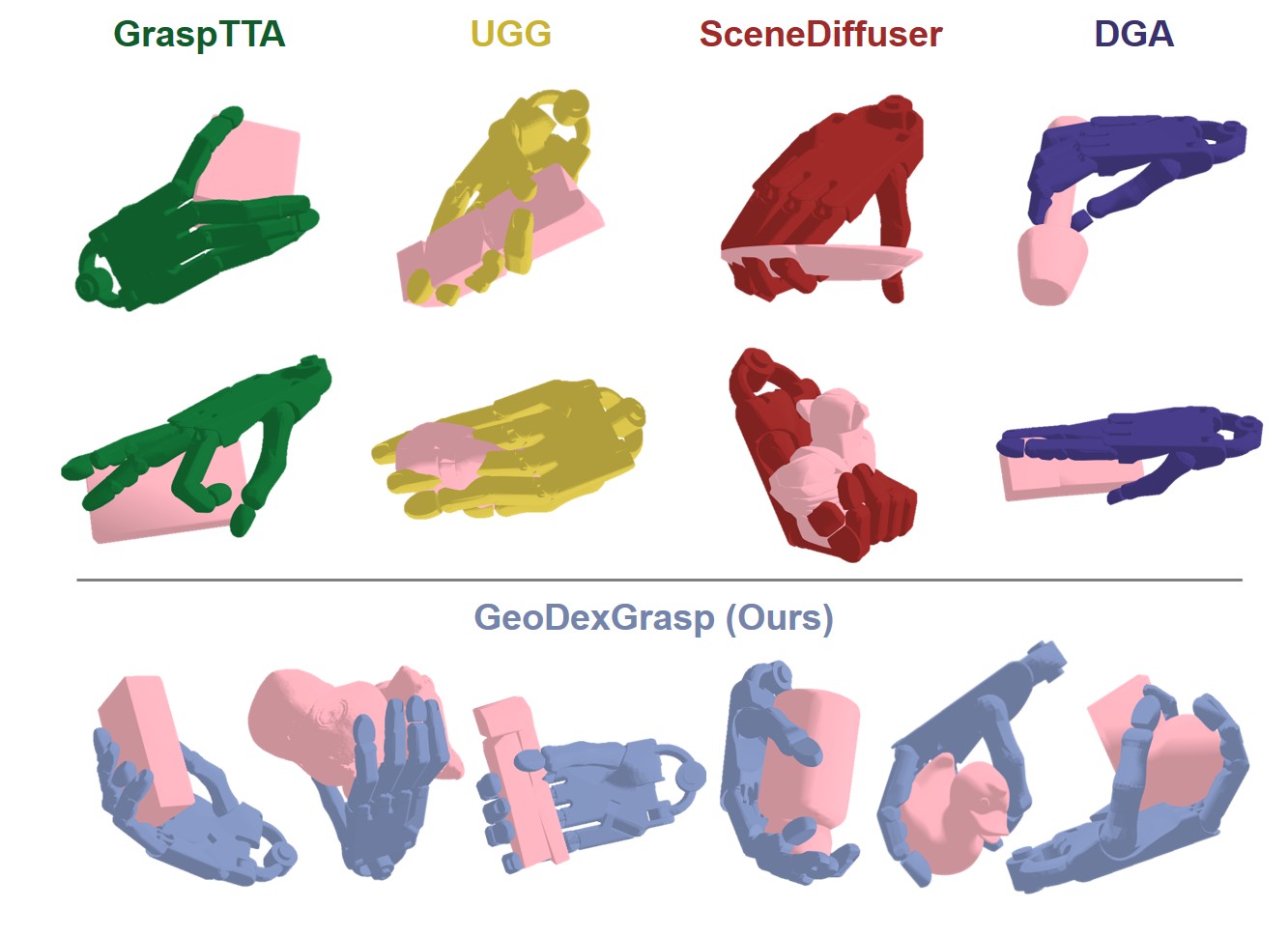
Experimental results 2

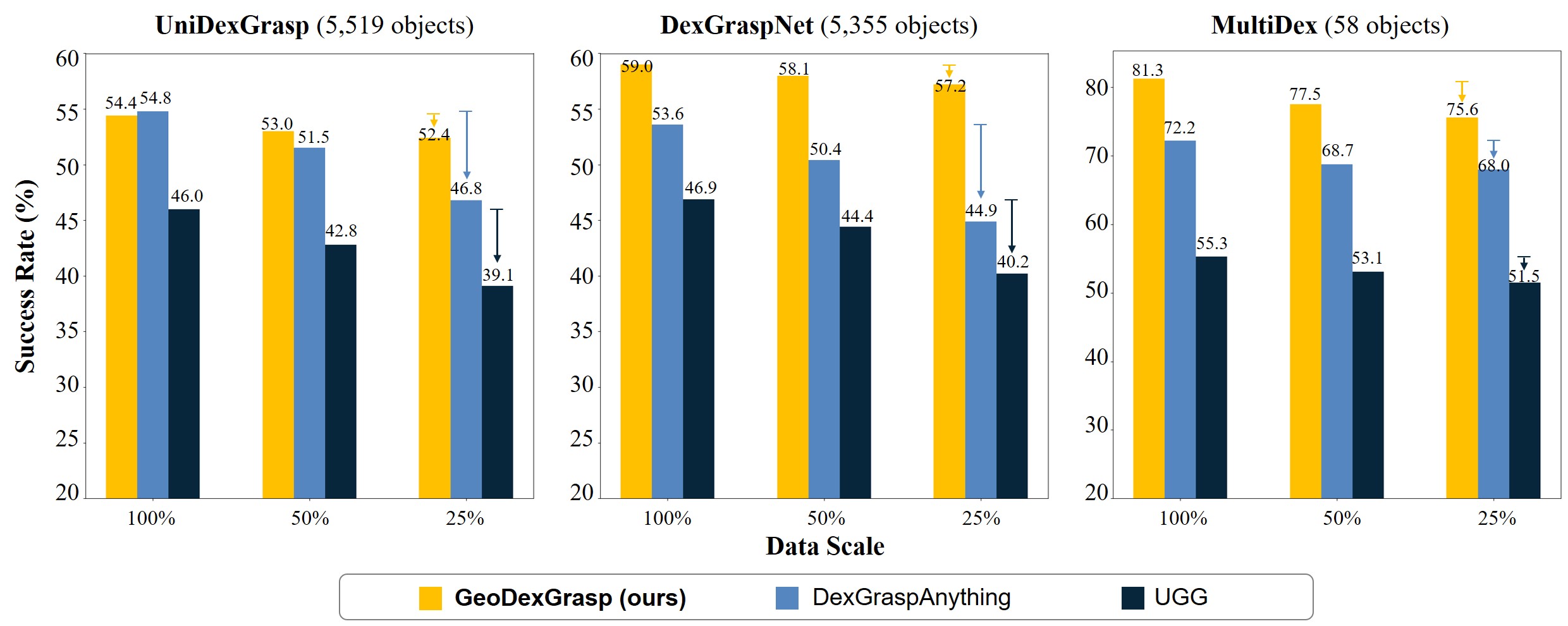
Data Efficiency

Data efficiency analysis

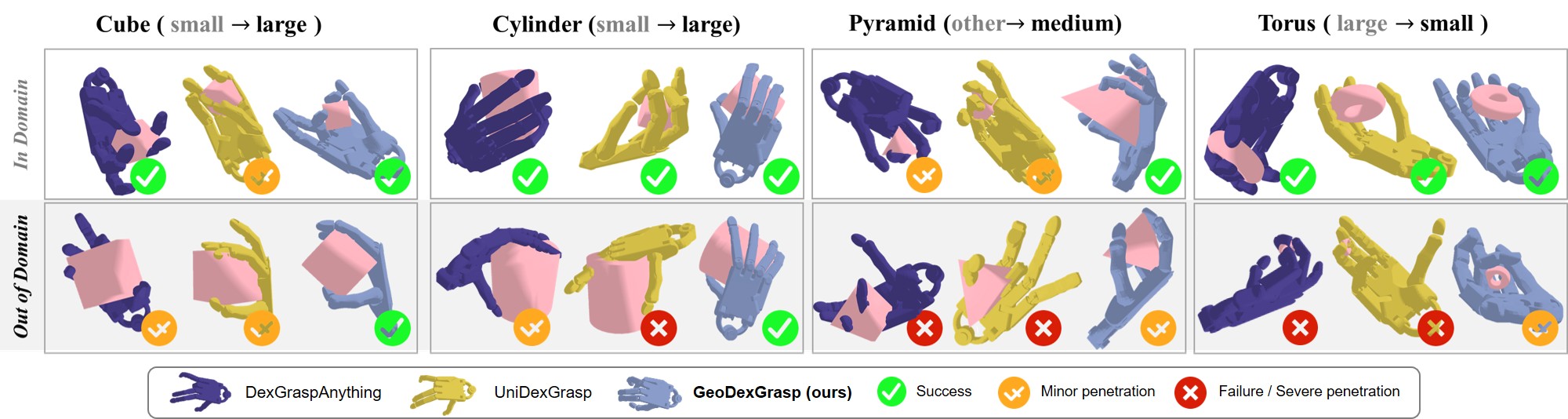
Size Generalization

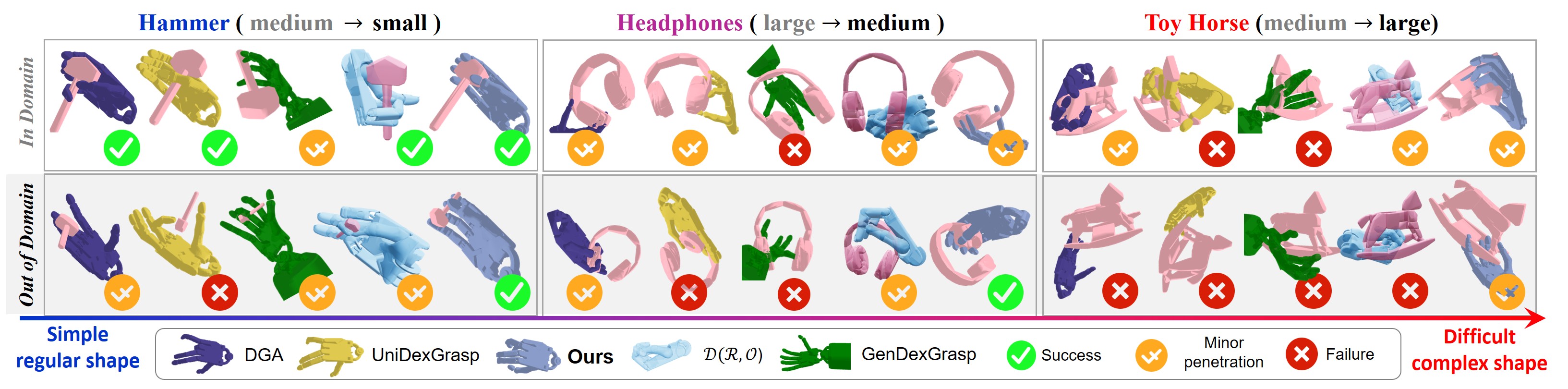
Size generalization results 1

Size generalization results 2

Size generalization results 3

Sim & Real Experiment

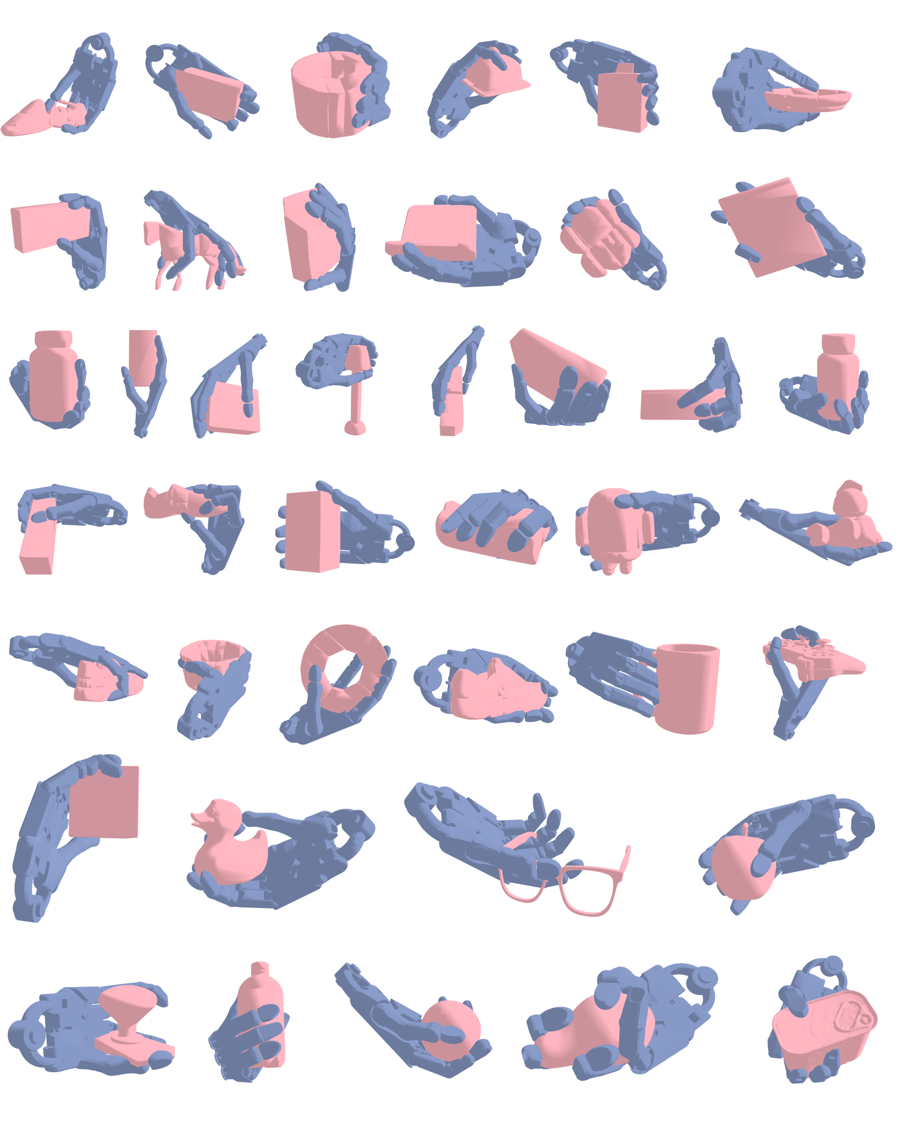
Simulation experiment result

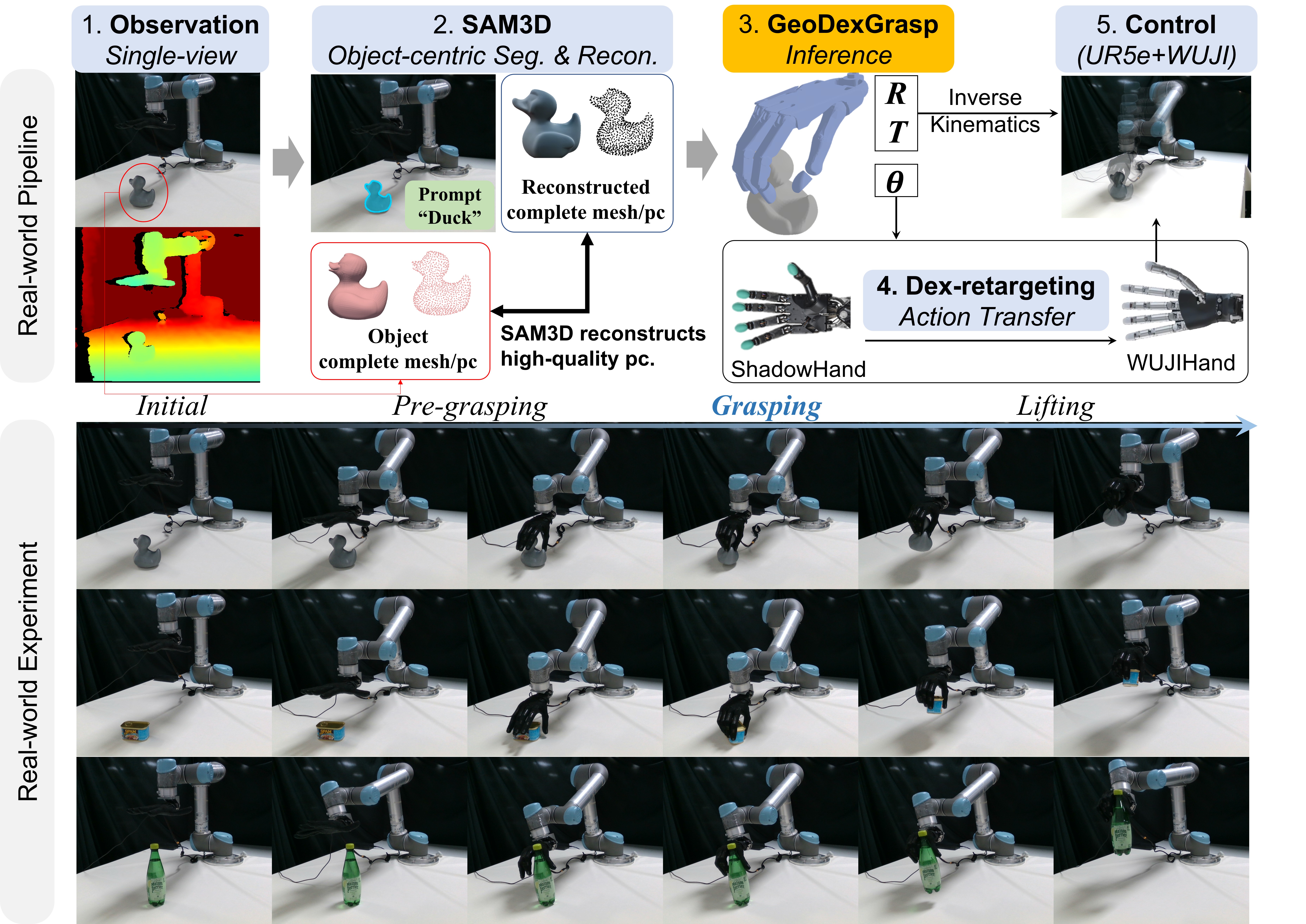
Real-world experiment result